
STRIDE-light Canvas
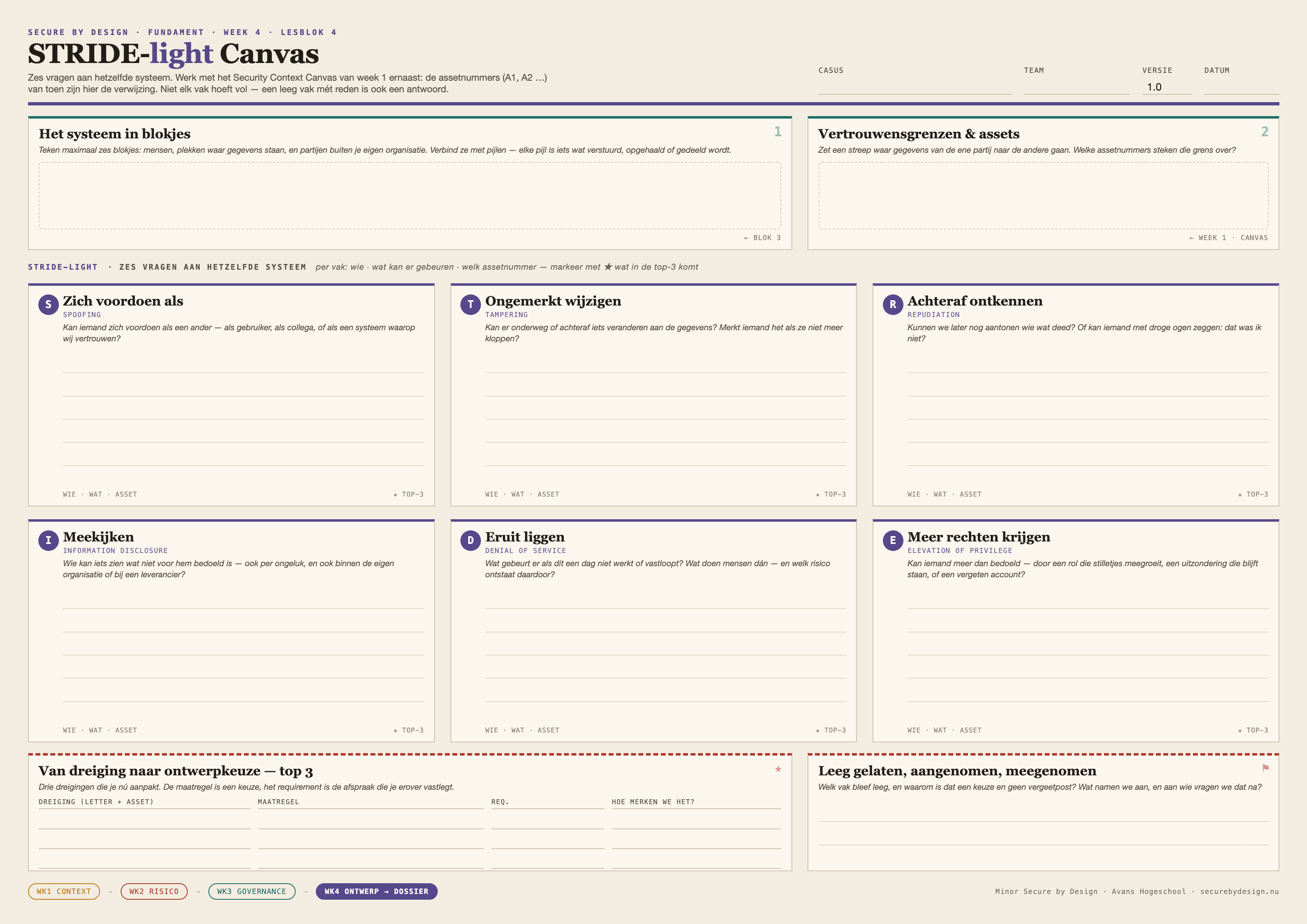
Threat modelling as a shared design language, on a single A3. Six questions asked of the same system — in plain language, so a non-technical student can ask them just as well. The canvas builds on the asset numbers from week 1 and delivers the top-3 threats that block 5 uses to fill the traceability matrix.
01 The canvas
One sheet, three bands: first the system, then the six questions, then what you do with them. Click the image for full resolution.
02 How to read it
The system in at most six blocks — people, places where data lives, parties outside your own organisation — and the trust boundaries between them, with the asset numbers that cross such a boundary.
STRIDE in plain language: impersonating, changing unnoticed, denying afterwards, looking in, being down, gaining more rights. Every question is asked of the same picture, and every answer notes who, what and which asset number.
Three threats you tackle now: measure, requirement number, and how you would notice it going wrong. Next to it, the strip for what you deliberately left empty or assumed.
Two things keep the canvas light enough for 50 minutes. Not every field has to be full — an empty field with a reason is an answer too, and that reason belongs in the strip at the bottom right. And R and D are not technical questions: “can we tell afterwards who did what?” and “what do people do when this is down for a day?” are about process and behaviour, and are exactly where non-technical team members come in.
03 What it connects to
The canvas does not stand alone: it inherits the asset numbers from week 1 and delivers the requirements that get their design choice in block 5. The link is again in the numbers — what was A1 in week 1 stays A1 here.
- Week 1 · block 9Security Context Canvasassets A1, A2 … + abuse cases
- Week 4 · block 3Architecture sketchthe system in at most six blocks
- Week 4 · block 4STRIDE-light canvassix questions → top-3 threats
- Week 4 · block 5Traceability matrixrequirement → design choice → dossier
04 Want to weigh in?
The canvas is still a proposal — feedback on the wording of the questions, the bands or the case is welcome. Use the feedback button in the corner, or get in touch. contact